
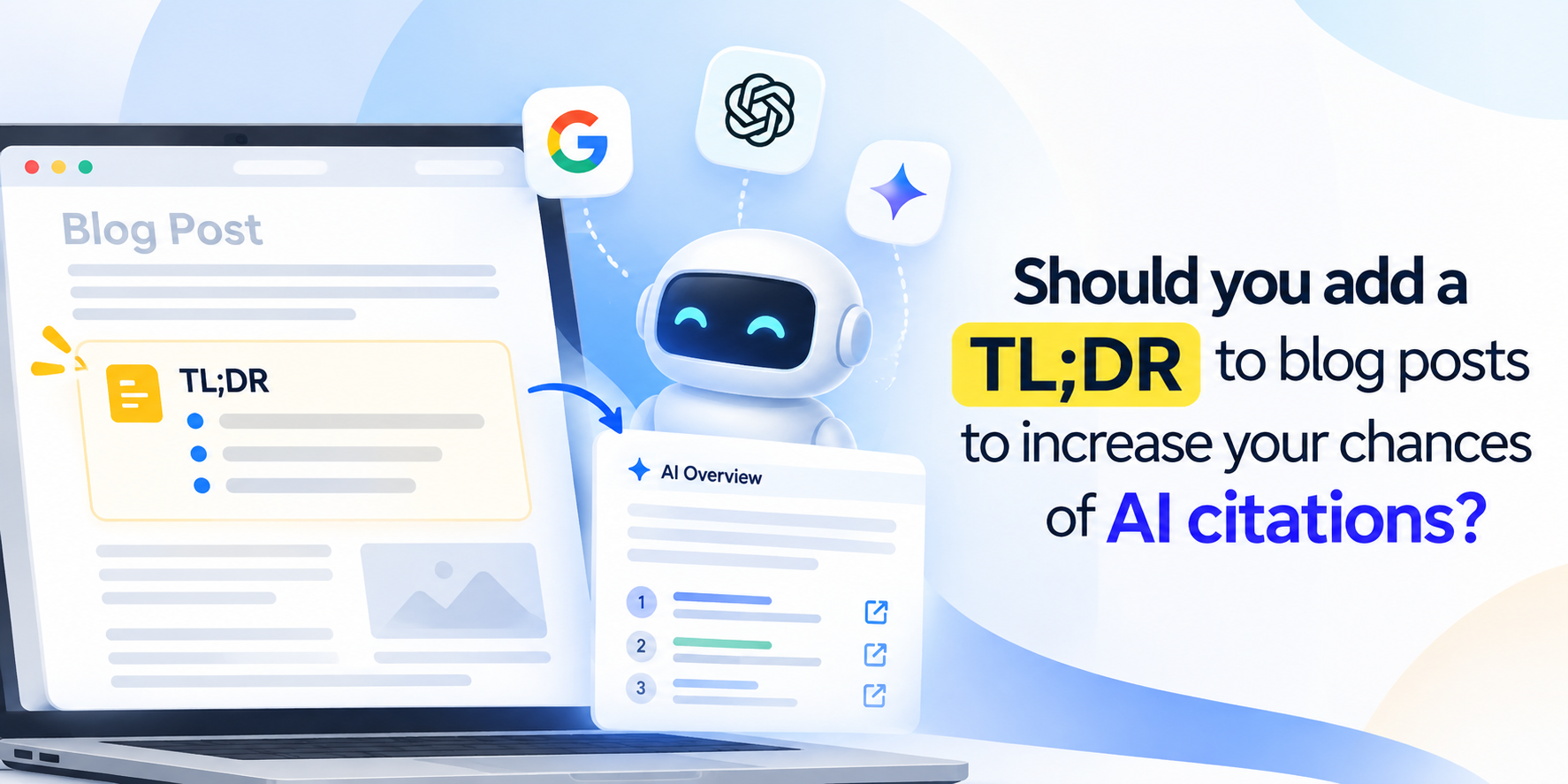
Probably yes, though not for the reason most SEO posts give. Nobody has shown that the label "TL;DR" does anything. What has some evidence behind it is putting your answer near the top of the page, and a summary box is one way to do that.
Kevin Indig looked at 18,012 verified ChatGPT citations and found that 44.2% came from the first 30% of the content. CXL ran a smaller check on Google AI Overviews. In their sample of 100 citations, 55% of the cited passages sat in the first 30% of the source page. A sample of 100 is thin, but it's a different AI system and it produced the same shape.
If your post spends 600 words on background before it says anything useful, that's a cost. The models seem to pick up text near the top more often.
Most of the "TL;DR boosts AI visibility" claims come from agencies selling AI search services. One vendor write-up is more candid than the rest: Google doesn't document TL;DR placement or length as a factor in choosing sources. Google's own guide goes further and tells site owners they can ignore tactics like chunking content, creating unnecessary AI text files, or pursuing inauthentic mentions. A TL;DR isn't chunking, but the spirit is the same: write for readers and don't engineer for the parser.
The case studies are less convincing than they look. One SEO applied a TL;DR block, numbered steps, an FAQ, and primary-source citations to his pillar posts, and citations went from 4 of 50 head terms to 19 of 50 over six weeks. That's a big jump, but he changed four things at once and had no control group. Seer Interactive's intern experiment changed five things on one blog post and saw it cited in an AI Overview, which has the same problem.
Measurement is also noisy. One person searched the same query ten times in an afternoon, and his page was cited in six of the nine renders that resolved and missing from three. A single before-and-after check can't tell you much. Ahrefs found something similar when it tested schema markup. Raw gains looked good, but the control pages had gained almost as much, because AI Mode was growing for everyone. A TL;DR study without controls could easily fool itself the same way.
Add a TL;DR when the post is long enough that a reader would want one and you can state the conclusion in two to four sentences. Give it the actual answer, with names and numbers in it. "In this post we'll explore" gives a model nothing to quote.
Don't stuff the head keyword into it. The same case-study author noticed that TL;DRs that felt over-optimized were cited less, not more. That's one person's observation, but it matches what you'd expect from text that reads badly.
If your post already opens with a direct answer, you may not need a box at all. In that case study, the four posts that were already being cited all opened with a clear, quotable paragraph answering the main query, with no TL;DR block in sight. The box isn't the point. The quotable answer near the top is.
Take 10 to 20 posts you'd like to see cited. Add a summary to half of them and leave the rest alone. Wait a few weeks, then check your target queries several times each. Google has a Generative AI performance report in Search Console that helps on the Google side.
Until someone runs that test at scale, a TL;DR is a cheap edit that helps readers and moves your answer up the page. That's reason enough to add one. It isn't enough to promise a client more citations.
Be the first to hear about our offers and announcements.


Copyright @ Hovo Digital - A Brand by Urbanklip Tech Private Limited
