
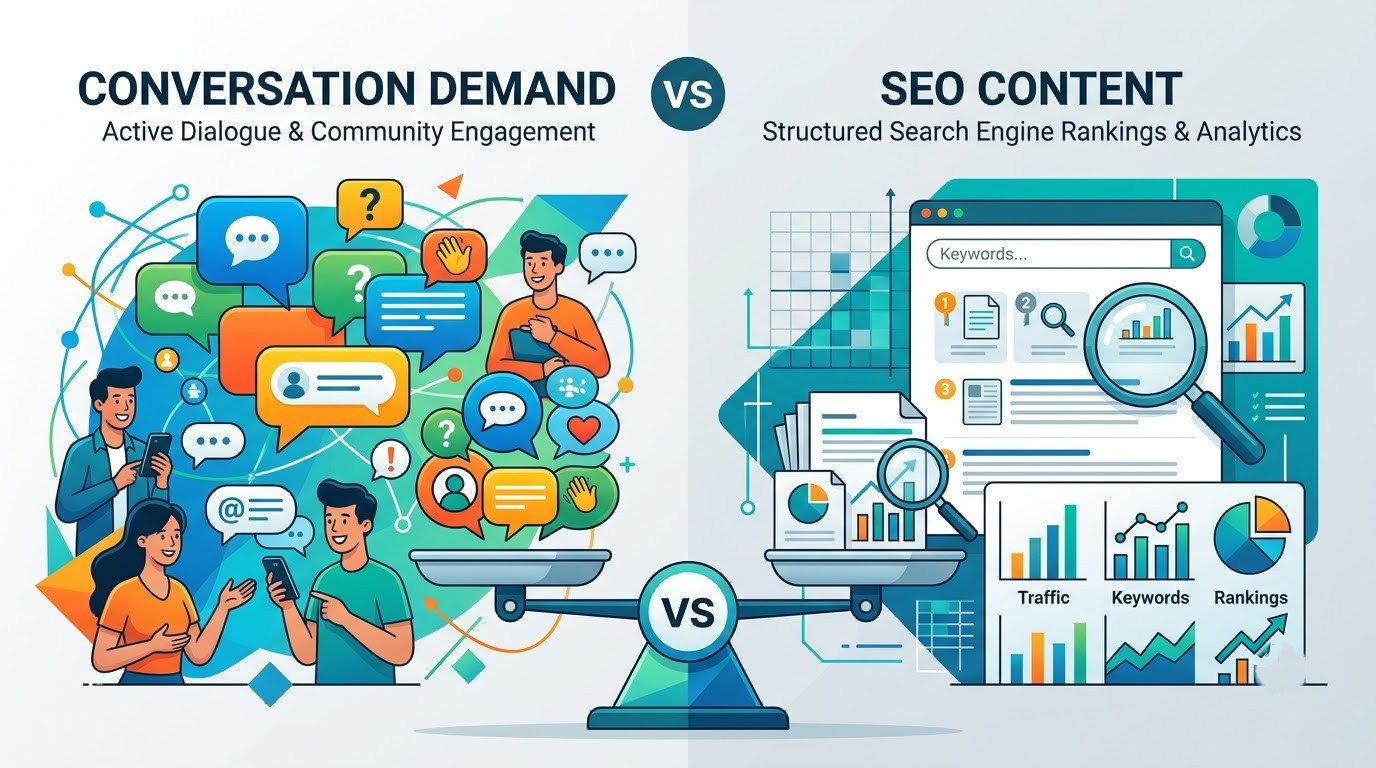
Start with SEO content if your site has thin coverage of core topics or low organic visibility — those gaps get penalized everywhere, including in AI answers. Start with conversation demand work (structuring content to answer real prompts people type into ChatGPT, Perplexity, and AI Overviews) once the foundational pages exist and you're losing visibility specifically inside AI-generated answers rather than in classic search results. In short: SEO builds the foundation, conversation demand determines what gets pulled into that foundation and cited.
Conversation demand refers to the questions people ask conversational AI tools, not the keywords they type into a search box. These prompts run longer and carry more context than a typical Google query. The average AI-driven search runs about 23 words, roughly five times longer than a traditional search query, and the intent behind it rarely fits a clean "informational" or "transactional" label.
That shift changes what "ranking" even means. Rather than ranking a list of links, AI systems select and synthesize information from multiple sources into one answer, so visibility now depends on being included in that answer rather than on holding a top spot. A page can rank #3 on Google and still never get quoted by an AI assistant, or vice versa.
Traditional SEO content work hasn't gone anywhere — it's the raw material AI systems draw from. AI systems depend entirely on human-created web content, authority signals, and existing SEO foundations, so without SEO, AI has nothing reliable to summarize. Keyword research, topical coverage, internal linking, and technical crawlability still decide whether your site even enters the pool of sources a model might cite.
This is the part teams tend to underweight once GEO and AEO enter the conversation. A brand with no SEO foundation isn't skipping a step by jumping straight to "AI optimization" — it's building on nothing.
| SEO Content | Conversation Demand | |
| Unit optimized | Whole page, keyword | Passage, specific answer |
| Query style | Short, 2–4 word phrases | Long, natural-language prompts |
| Success metric | Rankings, clicks | Citations, mentions, share of voice |
| Content shape | Comprehensive pillar pages | Direct, extractable answers |
| Research source | Keyword tools (Ahrefs, Semrush) | Real prompts from support tickets, sales calls, chat logs |
AI-powered search engines assess specific passages rather than whole pages, since responses get blended from multiple sources, so each paragraph or subsection needs to deliver a focused, complete answer on its own. That single fact is why the same article can perform well in Google and poorly in an AI answer, or the reverse — the page might be excellent, but no single passage stands alone as a citable answer.
Three questions can settle most prioritization arguments:
Teams with mature SEO programs and low AI visibility should lean toward conversation demand work. Teams with sparse content libraries should build SEO foundations first, because appearing in AI answers now requires knowing the exact questions an audience asks and mapping conversational prompts to content, which is difficult to do on top of thin or missing coverage.
Guessing at prompts wastes effort. Sales calls, customer support tickets, and onboarding sessions hold precise, authentic language that reflects what people actually ask, making them a better prompt source than keyword tools alone. Pull recurring phrasing from those sources before writing new sections, then check whether AI tools already answer those questions using competitor content instead of yours.
What is conversation demand in SEO?
Conversation demand is the set of long, natural-language questions people ask AI tools like ChatGPT or Perplexity, as opposed to short keyword phrases typed into a search bar. It shapes which passages get cited in AI-generated answers.
Should I prioritize SEO or GEO first?
Prioritize SEO content first if core topics are missing or thin. Prioritize GEO and conversation-demand formatting once solid content exists but isn't appearing in AI-generated answers for queries it already ranks for.
Does good SEO content automatically perform well in AI answers?
Not automatically. A page can rank well on Google while no single passage is structured as a self-contained, extractable answer, which keeps it out of AI citations even with strong rankings.
Where do I find real conversation-demand questions?
Customer support tickets, sales call transcripts, and onboarding conversations tend to hold the actual phrasing customers use, which is usually more accurate than keyword-tool suggestions alone.
Be the first to hear about our offers and announcements.


Copyright @ Hovo Digital - A Brand by Urbanklip Tech Private Limited
