
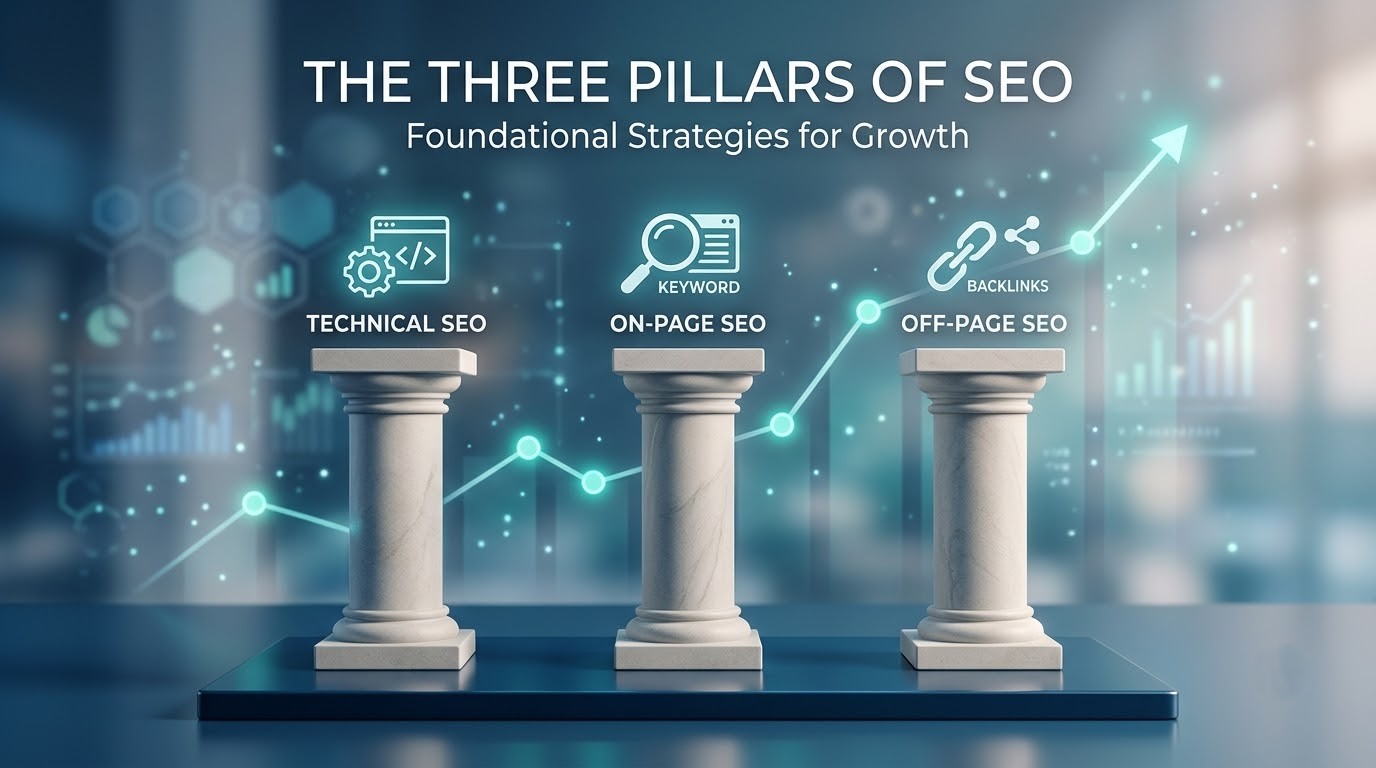
The three pillars of SEO are technical SEO, content (on-page) SEO, and authority (off-page) SEO. Technical SEO makes a site crawlable and indexable. Content SEO makes it relevant to what people are actually searching for. Authority SEO builds the trust signals, mainly backlinks and brand mentions, that convince search engines your site deserves to rank. Take away any one of these and the other two lose most of their value. A technically flawless site with thin content still won't satisfy searchers, and brilliant content on a site Google can't crawl will never get seen in the first place.
You'll run into different labels depending on where you read about this: "on-page" instead of "content," "off-page" or "link building" instead of "authority." The framework underneath stays the same regardless of who's naming it. Organic listings still take the lion's share of clicks on a results page, with research on click behavior putting roughly 73% going to organic results rather than paid placements. That's a lot of traffic riding on getting all three pillars right, not just the one you happen to be best at.
This piece covers what each pillar actually does, what order to work on them in, what happens when you neglect one, and how to keep them balanced as AI-powered search changes the game.
Quick roadmap:
Technical SEO comes first because Google can't judge your content or your authority on a page it can't crawl, render, or index. It's the gate everything else has to pass through, not just "the most important" pillar. If your site throws errors, blocks crawlers, or loads too slowly on mobile, your content quality and backlink profile don't matter much. Search engines never fully process the page to begin with.
Technical SEO covers the infrastructure layer of your site:
A pattern I see a lot: teams pour resources into content while technical debt (broken canonical tags, duplicate content, slow-loading templates) quietly limits how much of that content ever gets indexed.
| Check | What to verify |
| Indexability | Pages aren't accidentally blocked in robots.txt or tagged noindex |
| Sitemap | XML sitemap is current and submitted in Search Console |
| Core Web Vitals | LCP, INP, and CLS scores pass in the "Good" range |
| Mobile rendering | Content and navigation work identically on mobile |
| Canonicalization | No duplicate-content conflicts across URL variants |
| HTTPS | Site-wide secure connection with no mixed-content warnings |
Technical SEO is rarely "done." It needs a re-check after every redesign, migration, or major content push.
Once a site is crawlable, content is what determines relevance, and relevance today means matching search intent precisely, not repeating a keyword a few extra times. Content SEO covers everything on the page itself: title tags, headings, body copy, internal links, and the structural cues that tell search engines and readers what a page delivers.
Modern content SEO leans heavily on E-E-A-T (Experience, Expertise, Authoritativeness, and Trustworthiness). Google's ranking systems weigh whether content shows real, first-hand knowledge of a topic, whether someone with relevant credentials wrote or reviewed it, and whether it's actually accurate rather than generic filler.
Core on-page elements worth getting right:
AI-powered search, Google's AI Overviews and AI Mode, ChatGPT, and Perplexity have raised the bar for structural clarity. These systems pull short, self-contained passages to generate answers, so content that buries its point in the fourth paragraph is much less likely to get cited than content that answers the question in the first two or three sentences of a section. Google's AI Overviews have grown a lot in reach: one analysis tracked their presence climbing from around 6% of searches in January to roughly 13% not long after, and that share has kept expanding as the format matures. The takeaway is simple: put the direct answer first, then support it, instead of building up to a conclusion at the end.
Authority is Google's way of outsourcing trust verification to the rest of the web. Backlinks, brand mentions, and reviews function as third-party votes that a site is credible enough to recommend. A page can be technically flawless and well written, but if no other reputable source references or links to it, search engines don't have much external evidence that it deserves to outrank established competitors.
Key authority signals:
Authority-building compounds slowly and rarely produces overnight results. That's exactly why it needs to run alongside content development instead of waiting until after.
Prioritize technical SEO first, or at least run it alongside content, start producing content early even while technical fixes continue, and treat authority-building as a continuous effort rather than a final stage. All three pillars need ongoing investment. The real sequencing question is where the next hour or dollar produces the most return right now.
Use these signals to decide where to shift focus:
Think of it this way: technical SEO is the foundation you keep inspecting, content is the structure you keep building, and authority is the reputation you keep earning. All three run on overlapping timelines, not sequential ones.
A weakness in any single pillar caps what the other two can achieve, no matter how strong they are on their own. These aren't three independent scorecards. They multiply each other's effect, and a zero in one category drags the whole result down.
Strong content, weak authority: Well-written, intent-matched pages still struggle to outrank established competitors in competitive markets without outside validation. Good content earns the right to rank. Authority signals are often what actually push it into top positions.
Strong authority, broken technical foundation: A solid backlink profile can't make up for pages that return errors, load slowly, or never get indexed. Link equity is essentially wasted if search engines can't crawl and process the pages receiving those links.
Strong technical setup, thin content: A fast, clean, well-structured site with shallow or generic content gets indexed easily, and then fails to satisfy what people actually searched for, which leads to poor engagement signals and high bounce rates that undermine rankings anyway.
High-trust industries are especially unforgiving here. In healthcare, legal, and finance, even a technically sound site with weak author credentials or missing expertise signals underperforms, because these topics get held to a stricter E-E-A-T standard. And strong content with no diversity in referring domains still struggles to rank competitively, even with excellent Core Web Vitals scores. The sites that keep compounding rankings over time tend to treat all three pillars as one connected system instead of three separate workstreams run by three separate teams.
Some practitioners now argue for a fourth pillar, user experience, or reframe the original three as authority, relevance, and experience. Both are worth knowing about, but the three-pillar core still holds up. What's changing is the definition of each pillar, not the count.
The three pillars of SEO- technical, content, and authority- depend on each other. They aren't a checklist you complete one at a time. Technical SEO gets you found, content makes you relevant, and authority earns trust. Neglect any one of them, and you cap what the other two can do. Use the readiness framework above to figure out where your next investment of time or budget should go, and revisit your technical foundation any time your site changes significantly.
Want to know where your site's pillars are out of balance? Start with a technical SEO audit. It's the fastest way to find out whether your content and authority work are even reaching search engines in the first place.
What are the three pillars of SEO?
The three pillars of SEO are technical SEO (crawlability, speed, indexability), content or on-page SEO (relevance, intent matching, E-E-A-T), and authority or off-page SEO (backlinks, brand mentions, reputation). All three need to work together for a site to rank and stay ranked.
Which SEO pillar is most important?
None of them wins in isolation. Each one caps how effective the other two can be. Technical SEO is foundational because it decides whether Google can process a page at all, but a solid technical setup alone won't produce rankings without relevant content and credible authority behind it.
How long does it take to see results from balancing all three pillars?
It depends a lot on site age, competition, and where your technical health starts out, but expect several months for meaningful movement, with authority signals usually taking the longest to compound. Fixing major technical issues tends to produce faster, more visible gains than content or authority work alone.
Is there a fourth pillar of SEO now?
Some practitioners are adding user experience as a fourth pillar, or reframing the classic three as authority, relevance, and experience. These are useful ways to think about SEO holistically, but they extend the original technical, content, authority framework rather than replace it.
Can a small business handle all three pillars without an agency?
Yes, especially with a phased approach: start with a technical audit and fixes, build a small set of genuinely useful pages matched to real search intent, then layer in authority-building (reviews, local citations, a handful of quality backlinks) once that content exists. The bigger challenge is usually finding the time to stay consistent, not lacking the expertise.
Be the first to hear about our offers and announcements.


Copyright @ Hovo Digital - A Brand by Urbanklip Tech Private Limited
